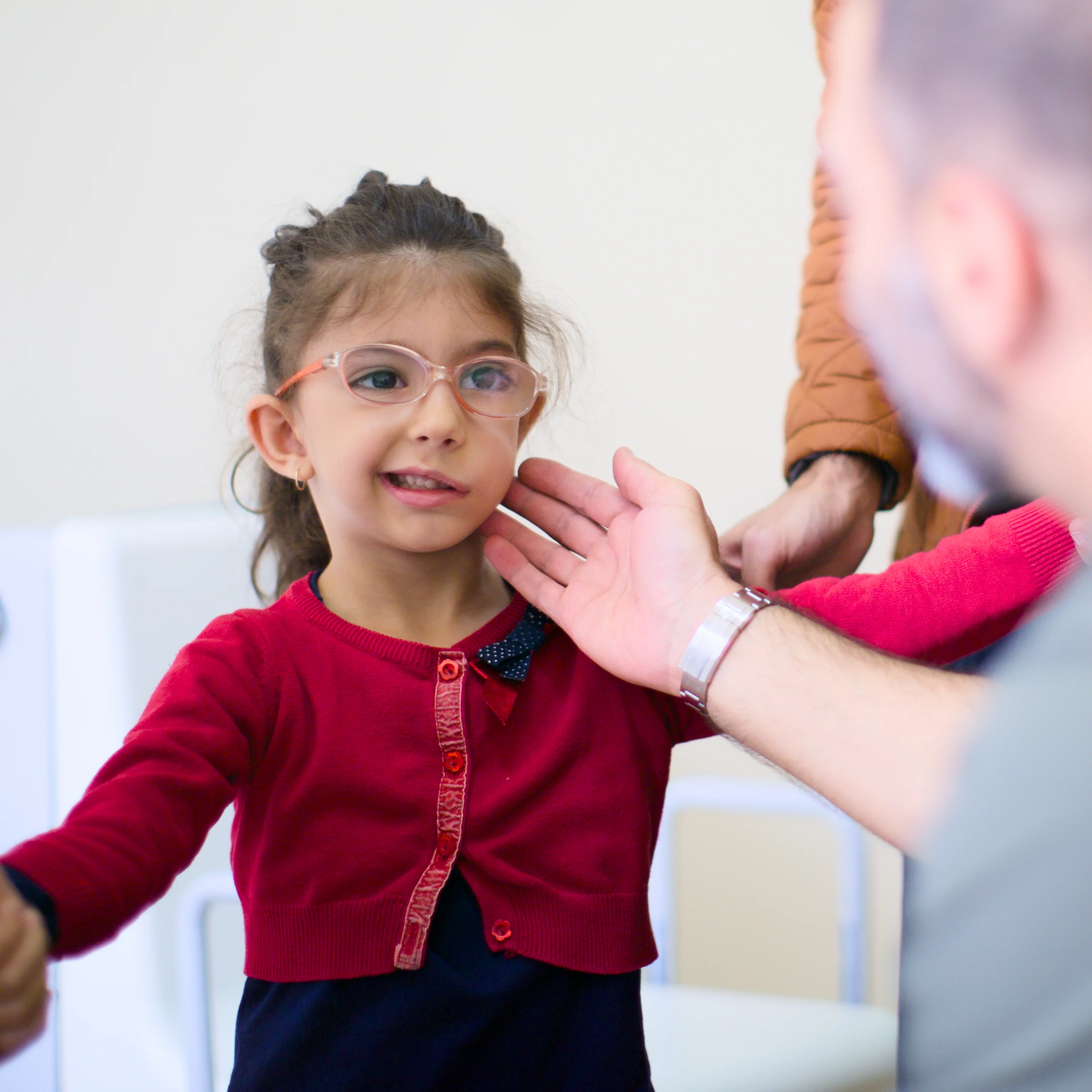

Facial paralysis is not a single condition — it's a spectrum. Every patient's anatomy, history, and goals are different. The Facial Nerve rejects one-size-fits-all solutions in favor of a tailored surgical plan that accounts for the cause of paralysis, its duration, the patient's age, and the specific movements they hope to restore.
Dr. Panossian doesn't just operate — he listens, educates, and guides each patient through a journey that begins long before the operating room and continues well beyond recovery. This is not assembly-line surgery. This is precision, patience, and partnership.
From the first conversation to long-term follow-up, every step is guided by Dr. Panossian personally.
Comprehensive evaluation of your condition, medical history, and goals — in person or via secure video for out-of-town patients.
Advanced imaging, electromyography, and functional assessments to map the exact state of nerve and muscle function.
Dr. Panossian designs a tailored surgical strategy — selecting from his full range of techniques based on your unique anatomy.
Microsurgical procedures performed with meticulous precision. Many patients travel from around the world for this day.
Structured post-operative care including physical therapy protocols designed to maximize nerve regeneration and muscle function.
Ongoing monitoring and adjustments as your nerve pathways mature — because optimal results develop over months and years.
Dr. Panossian treats the full spectrum of facial nerve disorders, from congenital conditions to trauma and tumor-related paralysis.
When facial function doesn't recover on its own, surgical intervention can restore symmetric movement and expression.
Children born without the ability to smile benefit from gracilis free muscle transfer to create natural facial movement.
Post-tumor removal facial paralysis treated with nerve grafting and muscle transfer techniques.
Immediate or delayed nerve repair following facial lacerations, fractures, or crush injuries.
Selective neurolysis and muscle management to correct abnormal facial movements from misdirected nerve healing.
Early intervention and staged reconstruction for children born with facial nerve underdevelopment.
Surgical resection of facial neurofibromas with meticulous reconstruction to restore form and function.
Facial reanimation after nerve damage from parotid, skull base, or head and neck surgeries.
Facial paralysis caused by herpes zoster reactivation in the facial nerve, requiring specialized treatment and potential surgical intervention.
Facial asymmetry and paralysis following stroke, with surgical options to restore symmetry and improve quality of life.
Loss of corneal sensation associated with facial nerve disorders, treated with corneal neurotization to protect vision.
Comprehensive surgical restoration of facial movement and expression through nerve and muscle transfer techniques.
Dr. Panossian draws from a comprehensive arsenal of microsurgical and reconstructive techniques — selecting and combining approaches based on each patient's unique needs.
When the facial nerve has been recently severed — whether from trauma or surgery — direct microsurgical repair offers the best chance for spontaneous facial movement. Using an operating microscope, Dr. Panossian meticulously realigns the cut nerve endings and sutures them together, allowing nerve fibers to regenerate along their original pathways. Timing is critical: the sooner the repair, the better the outcome.
A cross-face nerve graft uses a sensory nerve harvested from the leg (typically the sural nerve) to connect a functioning facial nerve branch on the healthy side to the paralyzed side. This creates a pathway for spontaneous, emotion-driven facial movement — when you smile naturally, both sides move together. The CFNG is often the first stage of a two-stage reconstruction, followed by a gracilis muscle transfer months later once the nerve graft has matured.
When the facial nerve itself cannot be repaired, other motor nerves can be redirected to power facial muscles. The masseteric nerve (which controls jaw clenching) is the most common donor — it provides a strong, reliable signal that patients learn to convert into a smile. Nerve transfers can be performed alone or in combination with cross-face grafts for a dual-innervation approach, giving patients both spontaneous and volitional smile capability.
The gracilis is a slender muscle from the inner thigh that is transplanted to the face using microsurgical techniques. Its blood vessels and nerve are reconnected under a microscope to restore blood supply and motor function. Once healed and reinnervated — typically powered by a previously placed cross-face nerve graft or a masseteric nerve transfer — the gracilis contracts to produce a smile. This is the gold standard for smile reanimation in long-standing facial paralysis.
The LTM is a single-stage procedure that repositions the temporalis muscle — already present in every patient's temple — to power a smile. Unlike free muscle transfers that require months of nerve regeneration, the LTM provides immediate movement on the operating table. Dr. Panossian has refined this technique to produce natural, symmetric smiles with minimal donor-site morbidity. It is especially valuable for patients who need reliable results without the prolonged waiting period of nerve grafting, and for those who may not be candidates for microsurgical free tissue transfer.
For patients with synkinesis — involuntary facial movements caused by misdirected nerve regeneration — selective neurolysis involves carefully identifying and releasing the problematic nerve branches. This interrupts the abnormal signaling pathways while preserving intended facial movement, reducing involuntary muscle contractions and improving facial symmetry at rest and during expression.
Facial paralysis often affects the eye, leading to corneal dryness and potential vision loss. Corneal neurotization restores sensation to the cornea by transferring sensory nerve branches to the affected eye. This allows the eye to regain its protective blink reflex and natural tear production — critical for long-term eye health and quality of life.
Static procedures complement dynamic reconstructions by addressing facial symmetry at rest. These include brow lifts to correct drooping eyebrows, lower eyelid tightening (canthoplasty) to improve eye closure, fascia lata slings to support the corner of the mouth, and facelift techniques to correct the sagging that accompanies long-standing paralysis. These procedures can dramatically improve appearance even when dynamic movement is limited.
Brow Lift for Facial Paralysis → | Eyelid Surgery → | Facelift → | Asymmetry Correction →
Botulinum toxin is a powerful adjunct in managing facial paralysis. Strategically placed Botox can relax overactive muscles on the healthy side to improve symmetry, calm synkinetic movements, and reduce muscle spasm. When used as part of a comprehensive treatment plan, Botox provides non-surgical refinement that enhances both surgical outcomes and day-to-day facial appearance.
Treating facial paralysis in children requires a distinct approach. Their nerves and muscles are still developing, which creates both unique challenges and remarkable opportunities for recovery. Dr. Panossian's craniofacial training gives him specialized expertise in pediatric facial reconstruction — understanding not just the surgery itself, but how growth and development will affect long-term outcomes.
For conditions like Moebius syndrome and congenital facial paralysis, early intervention can be transformative. The gracilis free muscle transfer, when performed in childhood, allows the transplanted muscle to grow with the child — and the results improve as the brain develops new neural pathways to control the new muscle.
Dr. Panossian and his team work closely with families throughout the process, providing guidance on timing, expectations, and the emotional aspects of treatment. Through his work with Mending Kids, he has also extended this care to children around the world who would otherwise have no access to reconstructive surgery.
Dr. Panossian welcomes referrals from neurologists, otolaryngologists, neurosurgeons, pediatricians, and other specialists. If your patient has facial paralysis from any cause — Bell's palsy, acoustic neuroma, trauma, congenital conditions, or post-surgical complications — we can help determine whether surgical intervention is appropriate and what approach would offer the best outcome.
We provide timely consultations, detailed operative reports, and ongoing communication throughout the patient's care. Virtual consultations are available for out-of-area patients to streamline the referral process.
Dr. Panossian is not only a surgeon but a researcher committed to advancing the field. His work on facial nerve reconstruction has been published in leading peer-reviewed journals and presented at national and international conferences. He received the ASPS Best Paper Award in 2016 for his research on nerve repair techniques — recognition from the world's largest organization of board-certified plastic surgeons.
His ongoing research focuses on optimizing outcomes in facial reanimation, developing novel techniques for nerve regeneration, and studying long-term results across different surgical approaches.
Facial paralysis can stem from various factors. Bell's palsy is the most common cause, often associated with viral infections that inflame the facial nerve. Other causes include trauma (fractures, lacerations, surgical complications), tumors affecting the facial nerve such as acoustic neuromas, congenital conditions like Moebius syndrome and hemifacial microsomia, stroke, and Ramsay Hunt syndrome. Seeking consultation from a facial nerve specialist is crucial for accurate diagnosis and determining the most effective treatment approach.
The potential for recovery depends on the underlying cause. Bell's palsy often resolves on its own or with medication within three to six months. For persistent or permanent paralysis, surgical interventions such as nerve grafts, nerve transfers, or muscle transfer procedures can restore meaningful facial movement and symmetry. Early diagnosis and treatment are paramount for optimal outcomes — the sooner Dr. Panossian can evaluate your condition, the broader the range of available options.
Acute facial paralysis refers to sudden-onset paralysis, often caused by conditions like Bell's palsy or trauma. Early intervention is critical in acute cases to prevent long-term complications. Chronic facial paralysis persists over an extended period and may result from conditions like Moebius syndrome, hemifacial microsomia, or unresolved nerve damage from tumors or surgery. Treatment approaches differ based on duration — acute conditions may benefit from medications, nerve repair, and early nerve transfers, while chronic cases typically require muscle transfer procedures such as gracilis free muscle transfer or lengthening temporalis myoplasty.
Treatment options vary based on the cause, duration, and severity of paralysis. For acute cases, medications such as corticosteroids and antiviral drugs may be prescribed, along with physical therapy and nerve decompression surgery. For chronic or permanent paralysis, Dr. Panossian offers a comprehensive range of surgical options including direct nerve repair, cross-face nerve grafting, masseteric nerve transfers, gracilis free muscle transfer, lengthening temporalis myoplasty, selective neurolysis for synkinesis, corneal neurotization, and static procedures for facial symmetry. Each treatment plan is customized to the individual patient's anatomy and goals.
Although stress itself is not a direct cause of facial paralysis, it can exacerbate existing conditions that might lead to paralysis. Stress weakens the immune system, making the body more susceptible to viral infections that could affect the facial nerve. However, stress alone is unlikely to cause facial paralysis. If you experience sudden facial weakness or paralysis, seek immediate medical attention regardless of the suspected cause.
Whether you've just received a diagnosis or have been living with facial paralysis for years, Dr. Panossian can help you understand your options. Schedule a consultation — in person or virtual.
Request a Consultation