
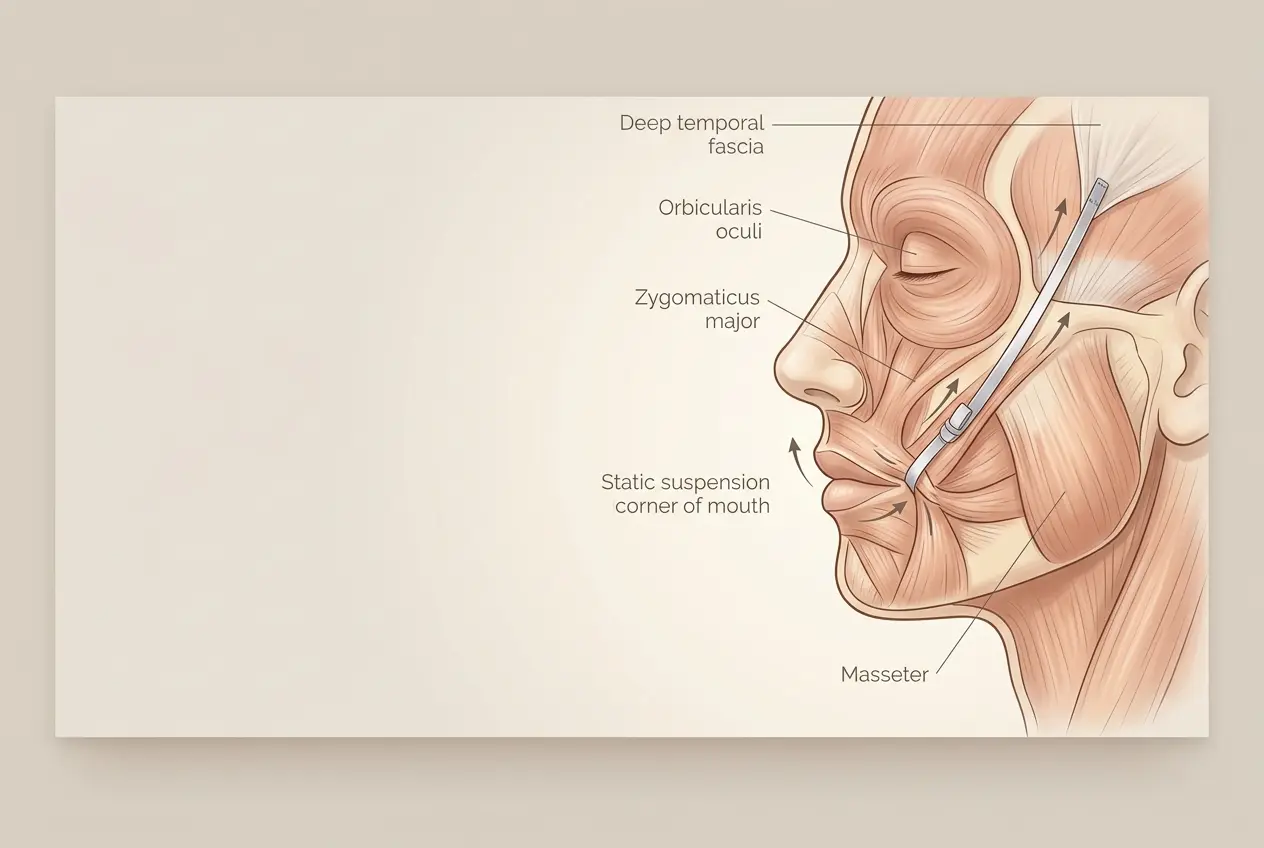
What is a static sling?
A static sling is a suspension procedure used in facial paralysis to support the corner of the mouth and lower face. When one side of the face is paralyzed, the affected side droops and pulls the mouth and cheek downward, creating noticeable asymmetry at rest. A static sling lifts and anchors that side back toward a more balanced, natural position, improving the appearance of the face when it is still.
It is important to understand that a static sling is exactly that — static, not dynamic. It improves resting symmetry, but it does not create movement and does not restore an active or spontaneous smile. Procedures that restore movement are known as dynamic reconstruction and include lengthening temporalis myoplasty (LTM) and free gracilis muscle transfer. For most patients seeking to regain a smile, Dr. Panossian prefers these dynamic options.
Who is a candidate for a static sling?
Dr. Panossian recommends the static sling far less often than dynamic options such as the lengthening temporalis myoplasty. However, it may have a meaningful role for select patients. It can be a reasonable choice for elderly patients, or for others who cannot undergo full general anesthesia or a longer reconstructive operation. In these situations, a static sling offers a less involved way to improve facial balance and quality of life.
Because every case is different, candidacy is determined individually. Dr. Panossian evaluates each patient's overall health, the duration and cause of paralysis, and personal goals before recommending a static or a dynamic approach. For patients who are good candidates for movement-restoring surgery, dynamic reconstruction generally remains the preferred path.
How is a static sling performed?
In general terms, a static sling uses a strip of supportive material to suspend the drooping corner of the mouth and lower face. The sling is anchored to stable, deeper tissues higher on the face so that the paralyzed side is lifted into a more symmetric resting position. The amount of lift is set during surgery to match the opposite, non-paralyzed side as closely as possible.
Because it does not rely on a functioning muscle or nerve, a static sling can sometimes be performed as a shorter, less extensive operation than dynamic reconstruction — one reason it may suit patients who cannot tolerate a longer procedure. The specific technique and materials are tailored to each patient during consultation.
How is the recovery for a static sling?
Recovery depends on the extent of surgery performed and the patient's overall health. Most patients can expect some swelling and bruising over the lifted side of the face that improves over the first one to two weeks. Activity is typically restricted in the early postoperative period, with heavy lifting, contact sports, and aerobic exercise avoided while healing. Because the result is static, the improvement in resting symmetry is visible early, though final settling continues as swelling resolves. Dr. Panossian's staff is available at all times to clarify any pre- or postoperative instructions that you were given.
Static vs. Dynamic: Understanding Your Options
The most important distinction in smile reconstruction is between static and dynamic procedures. A static sling improves how the face looks at rest but does not produce movement. A dynamic procedure restores actual motion, allowing the corner of the mouth to move and, in time, to smile. For most patients who are healthy enough to undergo it, lengthening temporalis myoplasty is Dr. Panossian's generally preferred, movement-restoring option, with free gracilis muscle transfer as another dynamic approach.
The static sling earns its place primarily as an option for those who are not candidates for dynamic reconstruction. Dr. Panossian will give you an honest, balanced assessment of which approach best fits your situation. To explore the full range of treatments, visit our facial paralysis treatment overview.
Explore Your Reconstruction Options
Dr. Panossian focuses his practice on facial reanimation and nerve reconstruction. He trained in facial reanimation under Dr. Ronald Zuker at the Hospital for Sick Children in Toronto.
Whether you are seeking answers about your condition or exploring surgical options, Dr. Panossian can help you understand your choices and develop a personalized treatment plan tailored to your unique needs.
Whether a static sling or a dynamic, movement-restoring procedure is right for you, Dr. Panossian can help you decide. Schedule a consultation to discuss your options.