
What is paralytic lagophthalmos?
Paralytic lagophthalmos is the inability to fully close the eye that occurs when facial paralysis weakens the muscles around the eyelids. When the eye cannot close completely, the cornea is left exposed. Over time, this exposure can lead to persistent dry eye, corneal scarring (keratitis), eye pain, excessive tearing, and in severe cases loss of vision. It is one of the most serious consequences of facial paralysis, which is why protecting and restoring eye closure is a priority in treatment.
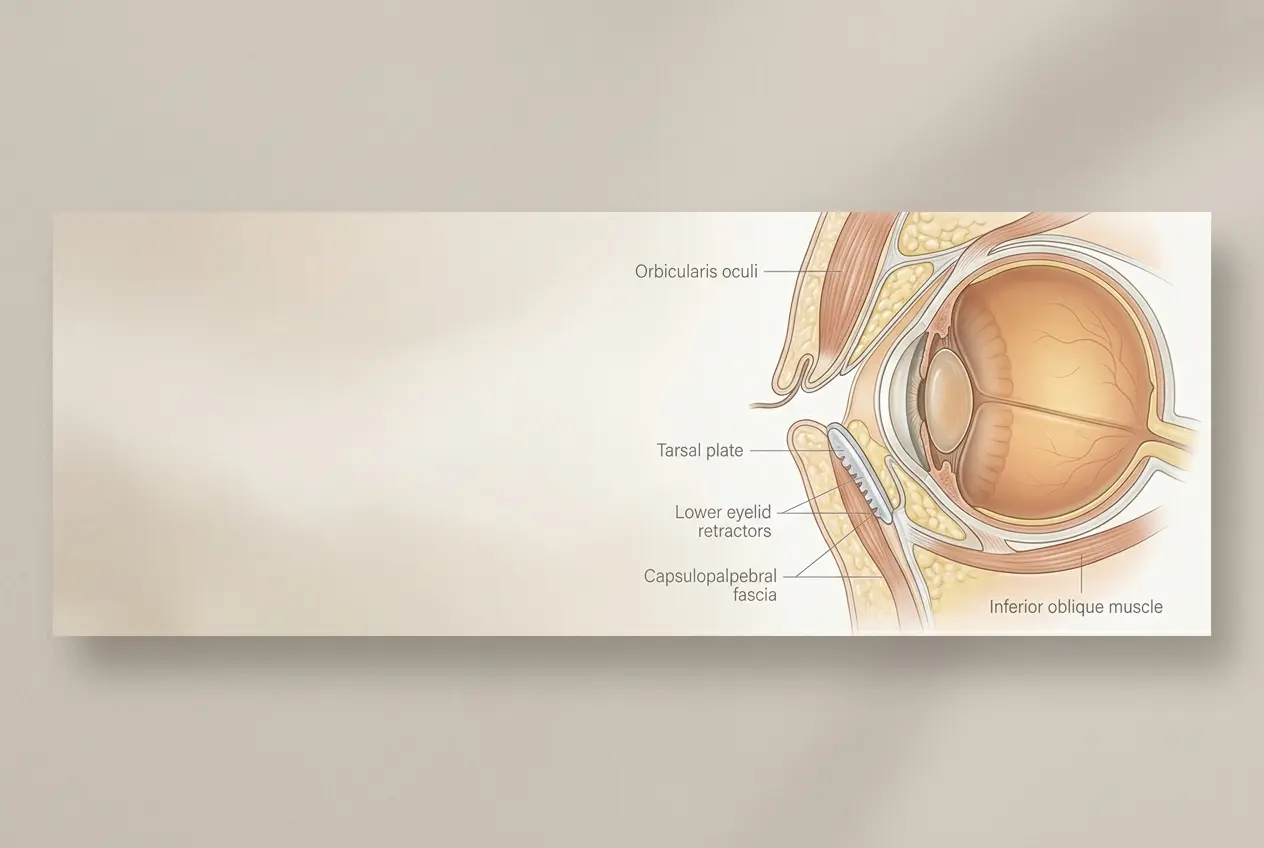
Lagophthalmos results from a combination of upper and lower eyelid dysfunction. This procedure focuses specifically on the lower eyelid. In facial paralysis, the lower eyelid loses its muscular support and sinks downward with gravity, often turning outward away from the eye — a condition known as ectropion. As the lower lid drops, it increases the distance the upper eyelid must travel to achieve closure, leaving a gap over the cornea. Repairing paralytic lagophthalmos and repairing the ectropic lower eyelid are essentially the same surgery: both restore lower eyelid support so the eye can close more completely. Because lagophthalmos arises from both eyelids, lower eyelid repair is often complementary to an upper eyelid weight procedure and other components of eyelid surgery for facial paralysis.
How is lagophthalmos (ectropion) repair performed?
To support the weak, drooping lower eyelid, Dr. Panossian usually uses a small mucosal graft taken from the hard palate or a graft of ear cartilage. This graft is placed to give structural support to the lower eyelid and lift it back toward the eye. By raising and stiffening the lower lid, the procedure reduces the work that the upper eyelid must do to achieve eye closure — closing the gap that allows the cornea to dry out.
The procedure is often combined with a lateral canthopexy and/or a tarsorrhaphy for additional support. A lateral canthopexy tightens the outer corner of the eyelid to elevate and reposition the lower lid, while a tarsorrhaphy narrows the eyelid opening so the lids meet more easily. Occasionally, for severe cases, Dr. Panossian will perform an orbicularis oculi based medial canthoplasty to provide support at the inner corner of the eye.
The specific combination of techniques is tailored to each patient based on the degree of ectropion and lagophthalmos present. An evaluation by an experienced ophthalmologist is an important step in assessing the health of the eye and guiding the surgical plan.
How is the recovery for lagophthalmos repair?
Depending upon the combination of techniques performed, surgery may be done under general anesthesia and is most often performed on an outpatient basis. Stitches are typically removed between 5–7 days after surgery. Swelling of the eyelids can occur but usually resolves over the first week, and any bruising improves during the same period. When a hard palate mucosal graft is used, the donor site on the roof of the mouth heals over the first one to two weeks. Activity is restricted during the first 4 weeks to light walking and stationary activities, with heavy lifting, contact sports, and aerobic exercise avoided during this time. Most adult patients elect to take approximately 3–7 days off from work. Scar management is started at 3–4 weeks postoperatively to support excellent healing.
What are the risks and complications of lagophthalmos repair?
Complications are uncommon with lower eyelid (ectropion) repair for facial paralysis. Standard risks associated with all surgeries apply. These can include bleeding (hematoma), infection, or adverse reactions to anesthesia. In adults, uncontrolled diabetes and smoking may affect healing and overall results. As with any eyelid repositioning procedure, there is always a risk of minor asymmetry, undercorrection or overcorrection, and the possible need for revision. To minimize your risk, pay close attention to your surgeon's instructions before and after surgery. Dr. Panossian's staff is available at all times to clarify any pre- or postoperative instructions that you were given.
Protect Your Eye Health
Dr. Panossian focuses his practice on facial reanimation and nerve reconstruction. He trained in facial reanimation under Dr. Ronald Zuker at the Hospital for Sick Children in Toronto.
Whether you are seeking answers about your condition or exploring surgical options, Dr. Panossian can help you understand your choices and develop a personalized treatment plan tailored to your unique needs. Learn more about the full range of options on Facial Paralysis, including eyelid surgery for facial paralysis and dynamic smile reanimation with lengthening temporalis myoplasty.
Lower eyelid weakness and ectropion from facial paralysis can threaten the cornea and vision. Schedule a consultation with Dr. Panossian to explore lagophthalmos repair options.